



Caffeine appears in many shampoos, serums, and scalp treatments marketed for hair growth, however, the evidence behind it is more limited than the marketing suggests. In today’s blog, we explore the science behind this popular ingredient and analyze the efficacy of it.
Why people use caffeine for hair growth
The idea behind caffeine as a hair growth ingredient starts with how it may interact with cells. Caffeine is thought to help fight back against a hormone called DHT, which is one of the main reasons hair follicles shrink over time, and hair gets thinner. This shrinking process, known as follicle miniaturization is a result of a hormonal process. The primary driver of hair miniaturization in androgenetic alopecia is androgen signaling, especially from DHT acting on genetically susceptible hair follicles. The hormonal process alters follicle biology, and miniaturization is the downstream consequence androgenetic alopecia or hereditary hair loss.
Another theory is that caffeine is a vasodilator, which means it widens blood vessels and improves circulation, which helps deliver vital oxygen and nutrients directly to the hair follicles. This increased blood flow is believed to help prolong the hair's growth (anagen) phase of the hair growth cycle.
What studies show
In a 2017 label trial of 210 men with androgenetic alopecia compared a 0.2% caffeine solution against 5% minoxidil solution over six months, caffeine has appeared to do soften the effect that testosterone has on follicle growth, lengthen the growth phase of the hair cycle, and encourage the follicle to produce more of a certain growth factor associated with healthier hair.
However, there was a major flaw in the study design: it used isolated hair follicles that were plucked, not those that were actively on a person’s scalp.
The study implemented trichograms, which involves plucking a number of hairs from the front and back of the scalp, putting them on a slide, and examining the root under a microscope to determine which stage of the growth cycle each one is in.
Furthermore, two of the study's authors were affiliated with the company that manufactures the caffeine product tested, which is worth factoring into how the result is interpreted.
None of this means the result is invalid. It means the result may not be as independently established as it is often presented to be, and a single industry-affiliated trial, however well-designed, may not be sufficient grounds for a broad claim that caffeine works for hair growth.
Why study quality matters as much as the result
A 2025 systematic review of clinical research on topical caffeine for hair loss examined multiple studies and found that most of them had a "very low" evidence rating.
This review flagged a few common issues:
- No control or comparator group at all
- Very small sample sizes, sometimes under 30 participants
- Caffeine tested as one ingredient within a 10-to-30-ingredient formula, making it impossible to isolate its individual contribution
- Short study durations that may not capture a full hair growth cycle
Only two studies in the review's chronology achieved a "medium" evidence rating, and even those had meaningful design limitations. The review's own authors concluded that caffeine may represent a promising avenue worth further study, while stopping short of describing it as a demonstrated treatment.
That is a fair summary: promising in the laboratory, inconsistently supported in the clinic, and not yet established at the level of rigor that would be expected for a treatment claim.
Conclusion: one ingredient was never going to be the solution
At, Hårklinikken, we do not use caffeine in its formulations, and this is not an oversight.
Hair loss is rarely the result of a single deficiency or a single receptor pathway. It may involve hormonal factors, an auto-immune condition, scalp microenvironment, oxidative stress, nutrition, and individual variation that no single active ingredient, however well studied, is likely to address on its own.
“This is also the more fundamental issue with how caffeine is often marketed for hair growth. It is presented as a standalone solution, applied at a single concentration, to every scalp, regardless of the underlying cause of thinning,” shares our Chief Scientific Officer, Dr. Panos Vasiloudes, triple-board certified dermatologist and PhD.
Even the most favorable data available measured a general population of men with androgenetic alopecia, not individuals whose hair loss may stem from different or overlapping causes.
The Hårklinikken approach
For 34 years, Hårklinikken has approached hair loss and thinning as a uniquely individual condition first, built on the premise that no two scalps are alike.
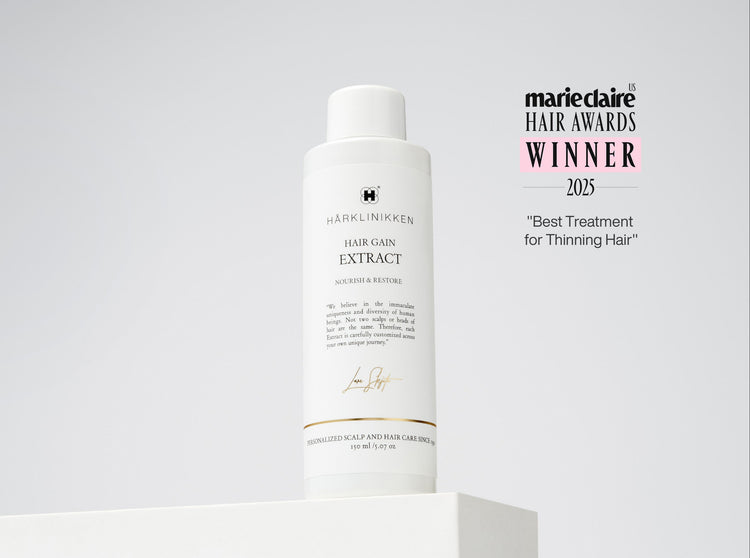
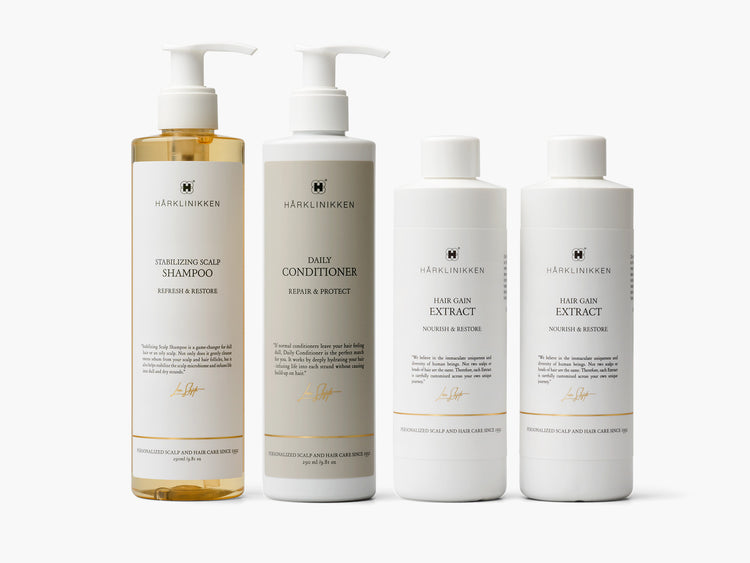
Rather than relying on one ingredient studied in isolation, founder Lars Skjøth and the clinical team, with Chief Scientific Officer Dr. Panos Vasiloudes, MD, PhD, formulate the Hair Gain Extract individually for each client, based on their unique scalp and hair biology.
This is a meaningfully different model than a single-formula product applied uniformly across a population. It is also one grounded in over 100,000 client cases from all over the world and more than three decades of in-clinic observation and refinement, clinical trials and real data, drawn from real people, rather than a single trial result generalized to everyone.
Where clinically studied, drug-free ingredients may support scalp health, they are considered as part of a personalized formulation instead of a stand-alone cure.
If you are interested in learning what a personalized, scalp-first approach may look like for your own hair and scalp health, schedule a consultation with one of our hair specialists.
Frequently Asked Questions
Does caffeine help with hair growth?
Some laboratory research suggests caffeine may influence hair follicle activity, and one clinical trial found it performed comparably to minoxidil. However, that trial has a disclosed industry conflict of interest, and most other clinical studies on caffeine are considered low-quality evidence, so a firm conclusion cannot be drawn based on present studies.
Is caffeine as effective as minoxidil for hair loss?
The 2017 study found a 0.2% caffeine solution to be noninferior to 5% minoxidil in men with androgenetic alopecia. However, two of the study's authors were affiliated with the company that manufactures the caffeine product tested, which is worth factoring into how the result is interpreted.
Why doesn't Hårklinikken use caffeine in its products?
At Hårklinikken, we’ve been testing caffeine solutions for several years and have not yet found it effective enough to include in our customized approach to optimize conditions for hair growth. Hårklinikken's approach centers on scalp-first, personalized formulations rather than single-ingredient solutions. Because hair loss may stem from multiple, individual factors, Hårklinikken formulates the Hair Gain Extract specifically for each client rather than relying on one studied ingredient applied uniformly.
by Heather Lim